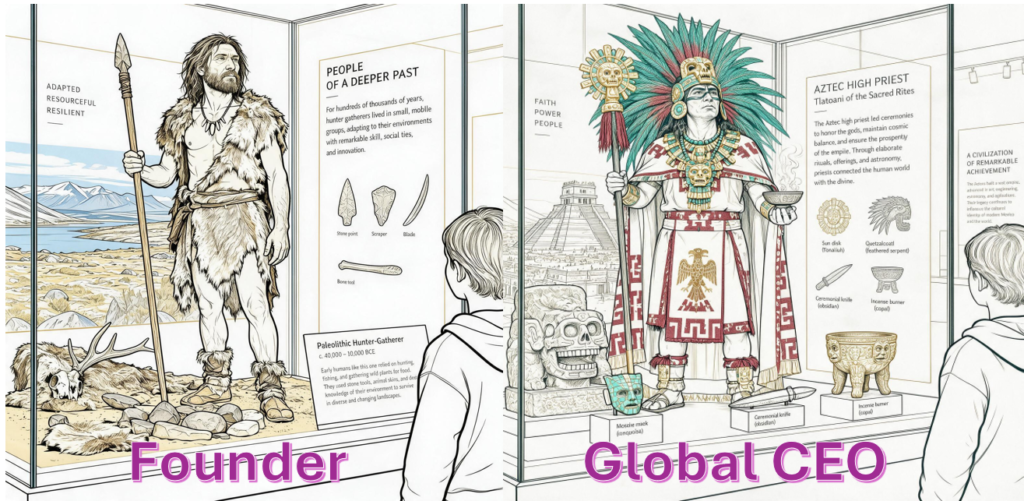
Were there parallels to contemporary micro-firms and today’s global corporate behemoths?
by Rob Farrow, SBA (www.sba-canada.com)
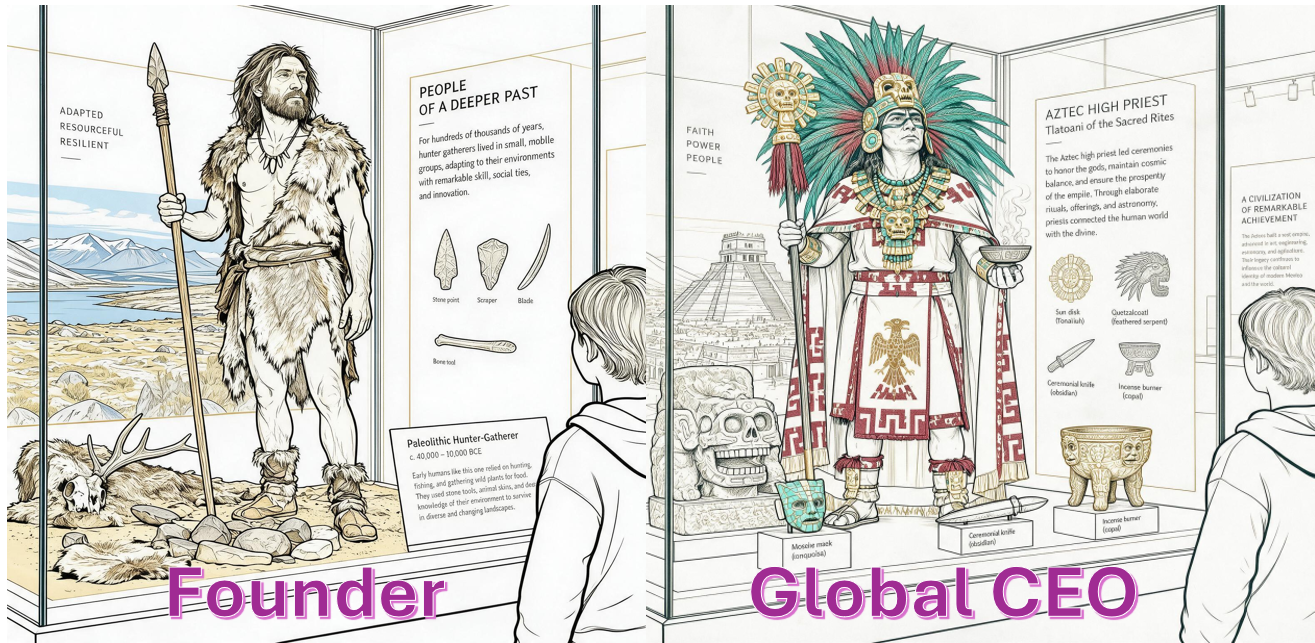
Both Dr. Luke Kemp – author of Goliath’s Curse – and Dr. James C. Scott – author of Against the Grain – two political scientists – paint an interesting portrait of early human civilization. I can’t help but draw parallels between our nomadic, hunter-gatherer ancestors and their subjugated agrarian cousins, and today’s self-employed entrepreneurs and their cousins employed by large, hierarchical businesses.
According to ChatGPT:
I think that is a genuinely fruitful analogy, provided we treat it as a comparison of organizational structures and incentives, rather than suggesting that a modern employee is literally equivalent to a coerced agrarian subject. In fact, your analogy brings out something common to both Scott and Kemp: the historical transition was not simply from primitive poverty to civilized prosperity; it was also from relatively autonomous ways of organizing production toward increasingly legible, appropriable, hierarchical ones.
Scott is especially useful here. His argument in Against the Grain is not simply that agriculture made people worse off. Agriculture and sedentism existed for thousands of years before states. The crucial development was the emergence of institutions capable of concentrating people, measuring production, extracting a surplus, and controlling labour. Grain was unusually suitable because it was visible, divisible, storable and taxable. Scott consequently describes early states almost as machines for capturing populations and agricultural surpluses. (Department of Political Science)
That produces an intriguing modern parallel.
| Scott’s world | Modern economic analogue |
| Mobile hunter-gatherer | Self-employed worker / micro-entrepreneur |
| Diverse subsistence strategies | Multiple customers/revenue sources |
| Mobility | Ability to change customers, markets or occupations |
| Limited accumulation | Small capital base |
| Relatively flat social organization | Owner-operated micro-firm |
| Sedentary grain farmer | Salaried organizational employee |
| Grain surplus | Economic surplus generated by labour |
| Tax/tribute | Organizational claim on that surplus |
| Scribe/administrator | Managerial/administrative hierarchy |
| Palace/temple/state | Large corporation/bureaucracy |
| Legibility of grain and population | KPIs, budgets, timesheets, job classifications |
| Escape to the periphery | Self-employment / entrepreneurship |
The especially interesting variable here is autonomy rather than income.
A hunter-gatherer could be materially poor by modern standards while possessing considerable discretion over when, where and how to work. But was he poorer than his agrarian cousin? The evidence suggests that he was physically larger and was healthier.
Similarly, a self-employed electrician, accountant, software developer or consultant might earn less than a senior employee of a major corporation yet exercise considerably greater control over work, customers, hours, methods and allocation of the resulting surplus. And, if you consider that workers earn a fraction of their charge-out rate while owner-managers earn a significant premium on every hour billed out for themselves (and their trainees), the income premium of working for an ‘elite’ business could be an illusion.
Conversely, joining a large organization can produce greater material security while surrendering some autonomy. The employee receives a predictable wage, infrastructure, specialized tools, insurance and organizational protection—but agrees to operate within somebody else’s hierarchy.
Scott’s idea of “legibility” makes the comparison stronger
This is where Against the Grain connects with Scott’s earlier Seeing Like a State.
Scott argues that centralized organizations struggle to govern messy reality. They therefore try to make it legible.
Early states preferred cereal agriculture partly because grain crops and agricultural populations could be counted, assessed and taxed. Scott contrasts this with diverse subsistence environments that were much harder for a central authority to measure and appropriate. (Wiley Online Library)
Large corporations face a remarkably similar information problem—not necessarily because they are oppressive, but because hierarchy requires abstraction.
A three-person business doesn’t need elaborate systems for understanding itself. Everyone can see what everyone else is doing. Once an organization has 30,000 employees, however, senior management cannot directly observe productive activity.
It substitutes representations:
hours → utilization → revenue → margins → KPIs → performance ratings → organizational charts → budgets → dashboards.
That makes economic activity manageable from the centre, but inevitably throws away contextual information.
And that connects particularly well with the distinction you’ve been making between micro-businesses and large organizations. A three-person accounting firm, construction contractor or engineering shop may appear administratively unsophisticated precisely because it doesn’t need the elaborate information architecture required by a hierarchical organization.
The absence of bureaucracy isn’t necessarily organizational backwardness. It can be an economically rational consequence of small scale.
Kemp adds the concentration-of-power dimension
Kemp’s Goliath’s Curse pushes the argument further. His “Goliaths” are large societies characterized by concentrations of hierarchy and power; he argues that increasing inequality and concentration of power frequently undermine their resilience. (PenguinRandomhouse.com)
That produces another interesting parallel with firms.
Small organizations frequently have little formal hierarchy because hierarchy would accomplish very little. If three people need to coordinate something, they talk to each other.
As organizations become larger, coordination increasingly becomes:
worker → supervisor → manager → director → VP → executive → board.
Capital simultaneously becomes more concentrated. Someone working independently may own nearly all the productive capital involved in the enterprise. A carpenter owns tools and a truck; a programmer owns a computer; a tax practitioner owns software and intellectual capital.
The employee of a large organization typically owns almost none of the productive apparatus and has little authority over the resulting surplus.
That does resemble—in an extremely attenuated and voluntary modern form—the structural transition Kemp and Scott are describing: production becomes progressively separated from control over production.
But there is one enormous difference
We shouldn’t romanticize either hunter-gatherers or self-employment.
Large organizations exist partly because hierarchy can generate enormous benefits from specialization, capital accumulation, risk pooling and coordination. A self-employed engineer cannot independently build a semiconductor fabrication plant, manufacture an airliner or operate a national telecommunications network.
And modern employment involves contractual exit rights and legal protections that distinguish it fundamentally from serfdom, slavery, corvée labour or the population capture Scott describes in early states.
So the more defensible analogy isn’t:
hunter-gatherer = free entrepreneur; farmer = corporate slave.
It is something subtler:
Both transitions involve exchanging some individual economic autonomy for the productive capacity, security and coordination available from a larger hierarchical system.
And that creates a trade-off rather than a simple progression.
It also challenges the conventional concept of “scale”
This may be the most interesting implication for your broader argument about micro-businesses.
Business education usually depicts organizational development roughly as:
self-employment → micro-business → small business → medium enterprise → large corporation
with an implicit upward arrow labelled growth.
Scott and Kemp suggest a different conceptual model. Increasing organizational size isn’t merely more of the same thing. At some point it produces a qualitatively different social organization characterized by hierarchy, administration, measurement, specialization and concentrated control.
That fits remarkably well with your “two solitudes” formulation. The distinction may not really be small versus large businesses. It may be between two fundamentally different production systems:
autonomous/networked production and hierarchical/administrative production.
Micro-enterprises sit overwhelmingly toward the first pole. Large corporations sit toward the second. Neither makes the other obsolete.
And that might explain something otherwise puzzling: why micro-businesses remain overwhelmingly numerous despite centuries of industrialization, enormous economies of scale and relentless predictions of consolidation. They may not simply be immature versions of corporations waiting to grow. They occupy an economic niche built around autonomy, flexibility, low administrative overhead and decentralized knowledge that hierarchy itself has difficulty reproducing.
That is very close to Scott’s larger insight: what looks from the centre like an inefficient, disorderly periphery may actually be a different and highly adaptive way of organizing human activity. (Yale University Press)
It also gives your “two solitudes” argument a stronger theoretical foundation than firm-size statistics alone: firm size is observable, but hierarchy, legibility, capital intensity and worker autonomy may be the underlying variables that make the two populations genuinely different economic organisms.