Eligible Dividends and the Small Business Deduction

EXAMPLE: Taxpayer with total income before dividends of approximately $30,000
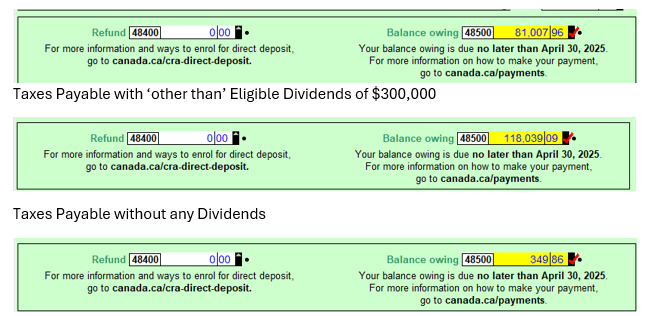
Actual Taxes Payable with Eligible Dividends of $300,000

The tax rate on eligible dividends is much lower than the rate on “other than eligible dividends” (see table below). However, there must be sufficient “general rate income pool” (GRIP) to pay eligible dividends from.

Dividends IncomeTax PayableAttributable to DividendsRelated TaxTax Rate on Dividends
None $                  30,000.00 $                              349.86 $                                                                          –    
Eligible $              330,000.00 $                     81,007.96 $                                               300,000.00 $                80,658.1026.9%
Not Eligible $              330,000.00 $                  118,039.09 $                                               300,000.00 $             117,689.2339.2%
Eligibile $      10,030,000.00 $             3,265,647.53 $                                       10,000,000.00 $        3,265,297.6732.7%

T5s for dividends must be filed by February 28th of the following year to avoid a penalty. However, the maximum penalty for a single late-filed T5 is just $100. Unfortunately, when we do the accounting at the end of the year it is difficult to know what the GRIP was when the dividends were theoretically paid (or at least deemed paid), on December 31st since the accounting and tax work had not yet been completed.

So, I dutifully issued the T5 on February 28th as being “other than eligible” dividends.

By the time I realized there was sufficient GRIP, I quickly filed an amended T5 (and T5 Summary). However, this was after the February 28th filing deadline. The CRA in their wisdom, determined that was not in fact an “amended” dividend filing, but a new filing and hence late-filed.

Since the penalty is trivial in relation to the tax savings, it seems counter-productive to argue that they are mistaken since the cost of making the argument is much greater than the penalty. What’s more, their determination was possibly correct in any event.

Taxes Payable with $10,000,000 in Eligible Dividends

Share:

Facebook
Twitter
LinkedIn

More Posts

Influencers and Experts

Mainstream news publications in Canada operate on very tight, near-zero profit margins, as total industry revenues have contracted sharply over the past two decades. But,

Academic Freedom or a Tax on Jobs

The grey (time) zone of academia The growing cohort of aging professors is raising intergenerational tensions on campuses The Editorial Board The Globe and Mail

Hunter-Gatherers vs City States

Were there parallels to contemporary micro-firms and today’s global corporate behemoths? by Rob Farrow, SBA (www.sba-canada.com) Both Dr. Luke Kemp – author of Goliath’s Curse

Built to Start, Not to Scale

by Rob Farrow, SBA (www.robfarrow.net) According to an article published in June of 2026 in The Globe and Mail, Canadian startups struggle to pass the

Canadian Tech Playbook

Here’s an enhanced, more polished version of your blog post—tightened for clarity, stronger flow, and a more provocative close, while keeping your core arguments intact:

VC-Backed FAAS

As a professional accountant with more than 3 decades of experience – including 5 years with the CRA as an auditor and 5 years with

About THE MAIN STREET JOURNAL

FIGHTING THE BIAS AGAINST SMALL BUSINESS

The Main Street Journal challenges the tendency to overestimate medium-sized and large businesses and overlook the smallest firms that make up Canada’s economy

THE REALITY OF CANADA'S SMALLEST BUSINESSES

Half of workers in business with fewer than 50 employees work for micro-businesses with 0-4 employees.

87%

of private-sector firms are self-employed or micro-business

0-4

employees defines a micro-business

99.7%

of Canadian firms are not large

WHY SMALL BUSINESSES ARE OVERLOOKED

BUSINESS SCHOOL

Focus on Fortune 500 companies

BUSINESS JOURNALISM

Follows firms with PR departments

SME CATEGORIES

Can hide the scale of micro-businesses

Our hope is to challenge our own perspectives and those of public-sector and corporate finance counterparts to deliver perspectives relevant to the ‘missing middle’ of Canada’s economy.