Influencers and Experts

Mainstream news publications in Canada operate on very tight, near-zero profit margins, as total industry revenues have contracted sharply over the past two decades.

But, unlike the tenuous profitability of mainstream media, social media platforms are highly profitable. As I write this, my concern is that social media content while ‘democratized’, has no perceptible link to ‘truth’ – whatever that is.

When I open Edge, I am treated to content that has clearly been selected for me based on my own biases.

In my view, there are two information ecosystems. The mainstream media have concentrated ownership and are subject to the biases of ownership. While there are journalistic standards at play, the underlying biases shine through.

Social media is fundamentally different. It is marketing driven. It tries to tell me what I want to hear in order to build an audience. There isn’t even an attempt to align content with something like objective reality.

Both information ecosystems bend reality to the biases of the publishers. But, in the case of social media, the biases (and often the publishers) are unclear.

The erection of paywalls to protect the content of mainstream media has the unintended effect of pushing increasing numbers of consumers to the empty echo chambers that social media have become.

Content aggregators—including the Microsoft Start/MSN feed built into Microsoft Edge have succumbed to the same clickbait economics that more nefarious actors exploit.


Share:

Facebook
Twitter
LinkedIn

More Posts

Academic Freedom or a Tax on Jobs

The grey (time) zone of academia The growing cohort of aging professors is raising intergenerational tensions on campuses The Editorial Board The Globe and Mail

Hunter-Gatherers vs City States

Were there parallels to contemporary micro-firms and today’s global corporate behemoths? by Rob Farrow, SBA (www.sba-canada.com) Both Dr. Luke Kemp – author of Goliath’s Curse

Built to Start, Not to Scale

by Rob Farrow, SBA (www.robfarrow.net) According to an article published in June of 2026 in The Globe and Mail, Canadian startups struggle to pass the

Canadian Tech Playbook

Here’s an enhanced, more polished version of your blog post—tightened for clarity, stronger flow, and a more provocative close, while keeping your core arguments intact:

VC-Backed FAAS

As a professional accountant with more than 3 decades of experience – including 5 years with the CRA as an auditor and 5 years with

ABOUT

Launch – June 16th, 2023

The MAIN STREET JOURNAL was launched online in 2023, as a kind of Canadian, small business counterpoint to the venerable WALL STREET JOURNAL (WSJ), established in New York City in 1889.

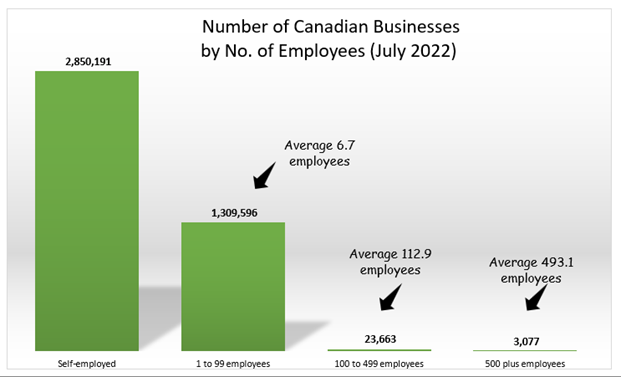
Canada’s small businesses are smaller than most people think.  

This is true for people that work in small businesses, for policymakers, business schools, and the business press. The self-employed and other small business owners don’t ‘get no respect’ and yet about 73% of private sector employment in Canada is made up of the 2.85 million self-employed individuals, and 1.3 million small employer businesses which average less than 7 employees. 

We believe it’s time that these workers, and the small business owner-managers that employ them, got some respect. What’s more, we believe that business schools and policymakers should get out of their ivory towers and take a walk on Main Street! 

Bar chart showing Canadian businesses by employee count (July 2022): 2,850,191 self-employed, 1,309,596 with 1-99 employees, 23,663 with 100-499, and 3,077 with 500+. Averages marked for each group. As highlighted in The Main Street Journal’s report on Falling Productivity in Canada, these figures provide important context to the country’s current business landscape.
73.2 % of private sector employment is provided by small business