The concept of ‘product – market – fit’ has been around for decades, beginning in Silicon Valley.
Today, these concepts have permeated thinking in most North American business schools. However, I would argue that regulated professions have failed to integrate the concept adequately into their own educational and professional training requirements. This has resulted in much longer professional education programs than would otherwise be necessary – particularly if large employers actually provided adequate ‘on-the-job-training’.
In our view, neither professional bodies nor the post-secondary education industry have the right incentive structure to deliver appropriately targeted professional training programs. In the case of professional bodies (particularly law and accounting), professional employers in Canada have been granted exemptions from employment standards legislation based upon a commitment to on-the-job training, much of which has been outsourced to universities. Universities benefit from these increased educational requirements.
However, we’d argue that too much of students’ efforts are, in fact, what Nobel Laureate (Economics) Michael Spence and economist Bryan Caplan would call ‘signaling’ to prospective employers. The result resembles a “tax on jobs” paid by employees.
Where the Concept of Product-Market Fit Came From
The concept of “product-market fit” was shaped by a small group of venture capitalists, entrepreneurs, and academics over several decades:
The Coiners & Popularizers
- Andy Rachleff — Benchmark Capital co-founder (and later Wealthfront CEO, plus a lecturer at Stanford Graduate School of Business) actually coined the term. He developed it from his analysis of the investing style of Sequoia founder Don Valentine. (Wikipedia, Unusual VC)
- Don Valentine — Sequoia Capital’s founder, whose market-first investment philosophy (“great markets pull products out of startups”) formed the intellectual foundation, though he never named it. (a16z)
- Marc Andreessen — Co-founder of Netscape and Andreessen Horowitz, who popularized the term in his 2007 essay “The Only Thing That Matters,” defining it as “being in a good market with a product that can satisfy that market.” He explicitly credited Rachleff, calling it “Rachleff’s Corollary of Startup Success.” (Holloway)
Academics & Entrepreneurship Educators
- Steve Blank — Stanford/Columbia lecturer and author of The Four Steps to the Epiphany, who positioned product-market fit as the stage between “customer validation” and “customer creation” in his Customer Development methodology.
- Eric Ries — Author of The Lean Startup, which built on Blank’s work and integrated PMF into the build-measure-learn loop.
- Alexander Osterwalder — Academic whose Business Model Canvas framework (value proposition, customer segments, channels) gave structure to how PMF is assessed.
- Bill Aulet — MIT Sloan professor whose Disciplined Entrepreneurship is a standard text on systematically reaching PMF.
Other Notable Contributors
- Sean Ellis — Entrepreneur who popularized the “40% rule” metric (at least 40% of surveyed customers would be “very disappointed” without your product) as a proxy for PMF. (Wikipedia)
- Arthur Rock & Pitch Johnson — Early venture capitalists whose “team-first” theses provided the counterpoint that helped clarify why market matters more. (a16z)
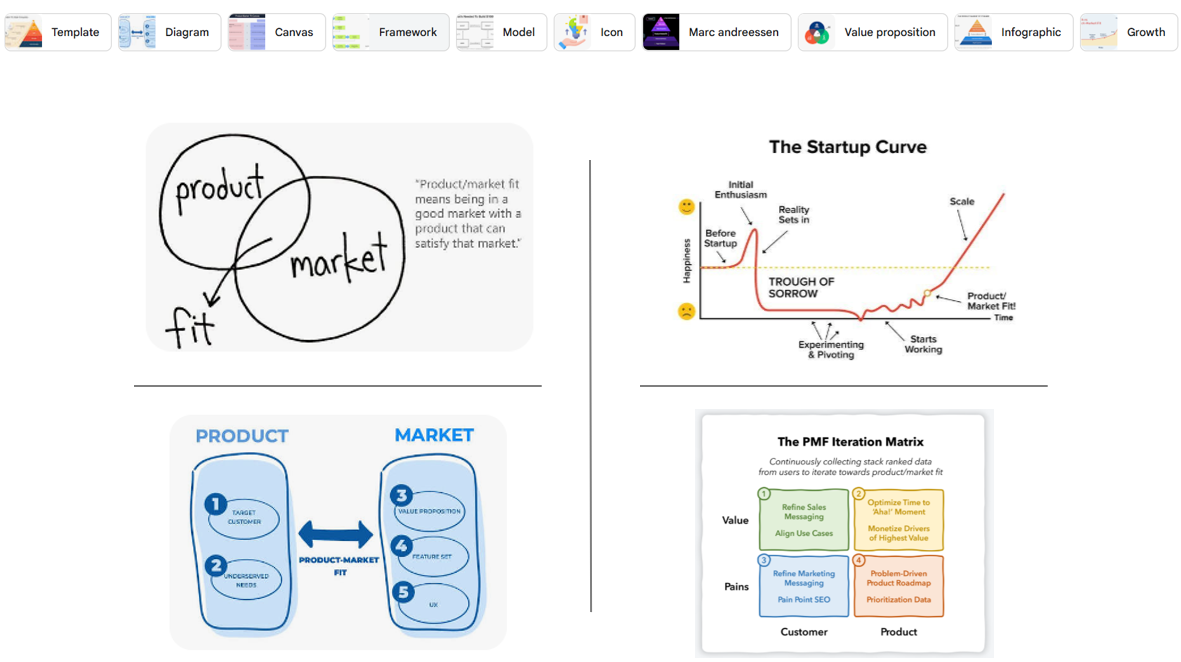
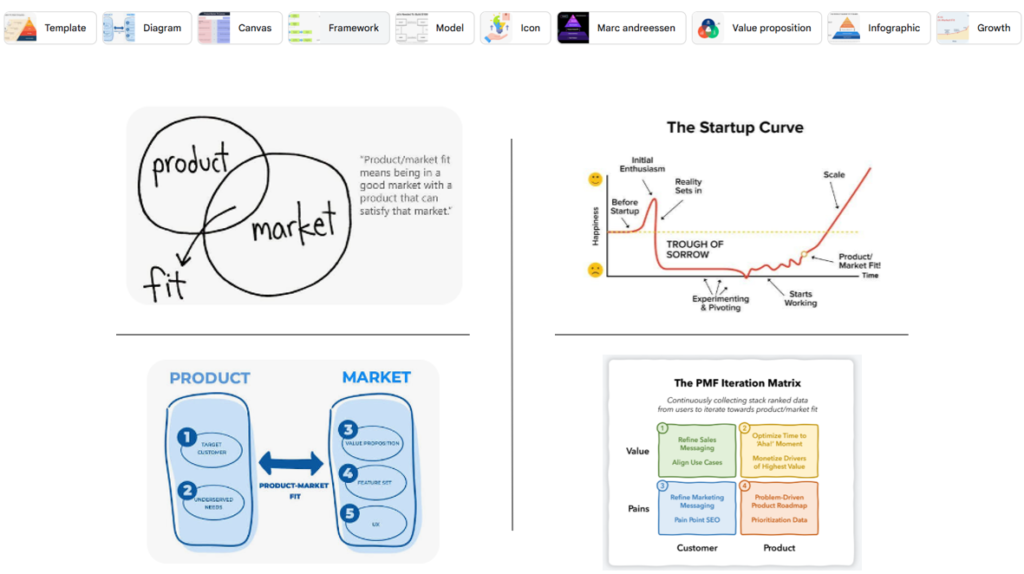
The illustration for this article came a Google search of Product Market Fit → images


Apparently, the concept is so popular there are many categories of images.
Not surprisingly, venture capitalists get most of the credit for developing the concept. Typically, they analyze a startup’s Product-Market Fit before investing. The Startup Curve illustration reproduced below was featured on The Venture Creator website linked to Marc Andreessen.
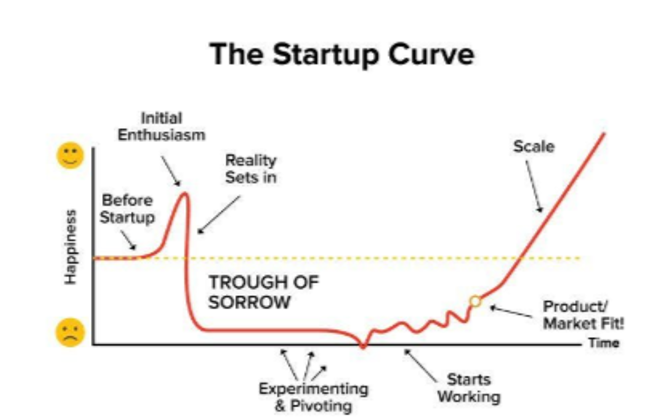
However, I’m not sure if there is any ‘real’ link to Mr. Andreessen. When I looked them up on CrunchbaseTM, it appears that the website owner was guilty of simple name-dropping.
Nonetheless, it is clear that venture capitalists like the idea of shifting costs to others. The VC skillset involves identifying target companies that have endured the ‘Trough Of Sorrow’ and found their ‘Product-Market Fit’ just before they are ready to scale.
I put this article together to assemble like-minded sources with concerns about the nature of contemporary business education
In particular, I wanted to review the main issues in Christopher Marquis’ 2024 book (The article in The New York Times (I Teach at a Business School. It’s Time to Shut Them Down.)
My sense is that other academics – for example, Henry Mintzberg and Jeffrey Pfeffer – have similar concerns to my own. From my perspective, business schools are too closely aligned with our largest employers. As a consequence – even though many teach ‘product-market fit’ – they ignore the skill sets required for working with the overwhelming majority of businesses with fewer than 10 employees.
Microsoft’s CoPilotTM
I’ll separate the strands: Marquis’s 2024 argument, the New York Times essay, Mintzberg and Pfeffer, then test how well they support your micro-business critique. I’ll also distinguish claims about business-school ideology from the more specific omission of sub-10-employee advisory skills.The first important distinction is now clear: Christopher Marquis’s 2024 book critiques the corporate system’s externalization of costs, while his New York Times essay is a later, much more direct critique of business-school design. Your sub-10-employee argument is compatible with both, but it is a distinct institutional-market critique that needs to be made explicitly rather than attributed to them. Your instinct is well founded, but it combines two related critiques that should be kept analytically distinct: [chrismarquis.com], [nytimes.com]
- Business schools reinforce a large-corporation model that permits firms to externalize social and environmental costs.
- Business schools treat the organizational problems of large employers as though they were the general problems of “business,” leaving micro-businesses almost invisible.
The first is central to Christopher Marquis. The second is stronger and, in my view, more original.
1. What Christopher Marquis argued in 2024
In The Profiteers: How Business Privatizes Profits and Socializes Costs, published May 14, 2024, Christopher Marquis examines how businesses capture private returns while shifting environmental, labour and social costs onto workers, communities, taxpayers and the natural environment. [indigo.ca], [books.google.com]
The book’s teaching guide divides the argument into three parts. [chrismarquis.com]
A. Business receives a “free lunch”
Businesses use public and common resources, including infrastructure, institutions, labour forces, communities and the environment, without necessarily paying the full cost of maintaining or restoring them.
This is more than the conventional economic concept of an occasional “externality.” Christopher Marquis presents cost externalization as a recurring feature of the economic system: corporate profitability may depend partly on excluding real costs from the firm’s accounts.
The central accounting question becomes:
Which costs appear in the corporation’s financial statements, and which are transferred to households, workers, governments, communities or future generations?
That framing is particularly relevant to your accounting background. A company can appear highly productive because its private accounts measure only the costs it is legally or contractually required to bear.
B. Society is encouraged to treat systemic costs as individual responsibilities
The book argues that businesses exploit the public commons while persuading people that repairing the resulting damage is primarily an individual responsibility. Its principal applications include carbon emissions, environmental degradation, cheap goods, low wages, inequality and systemic discrimination. [chrismarquis.com]
This produces an important ideological shift:
- business decisions are framed as economically necessary;
- the resulting damage is framed as a personal-consumption problem;
- businesses retain the profits;
- individuals and governments inherit the remediation costs.
C. Voluntary corporate responsibility is inadequate
The title’s language is deliberately stronger than ordinary ESG criticism. The problem is not simply that a few corporations behave badly. It is that the prevailing system encourages and rewards behaviour that transfers costs outside the firm. The teaching guide describes the underlying regime as broken and says the remedies must operate through policy, investment, business and consumer institutions, not corporations alone. [chrismarquis.com]
D. The proposed alternative is regenerative, not merely less harmful
Christopher Marquis examines entrepreneurs and organizations attempting to internalize their impacts and create positive social value. The later chapters address governance concerned with the commons, alternative finance and ownership, corporate activism and consumption. [chrismarquis.com]
The proposed transition is therefore approximately:
profit maximization subject to legal constraints
→ stakeholder responsibility
→ business models that maintain or regenerate the commons on which they depend
2. The later New York Times essay sharpens the institutional critique
One date clarification: I Teach at a Business School. It’s Time to Shut Them Down is a later essay, not part of the 2024 book. The available New York Times author and subject pages identify it as a guest essay by Chris Marquis, with the summary: “Students come in with noble intentions and leave with flawed expertise.” [nytimes.com], [nytimes.com]
A November 2, 2026 commentary reports that the essay was published on October 18, 2026. It describes the essay’s criticism as directed at business schools’ emphasis on deal-making, simplification and optimization; the movement of students toward consulting and finance; and use of the case method to present problems from the perspective of a senior executive, frequently through sanitized company narratives. It also reports Christopher Marquis’s subsequent clarification that he favours fundamental curriculum redesign rather than literally abolishing the institutions. [forbes.com]
That connects the essay to the 2024 book:
- The book asks why corporations are allowed to externalize costs.
- The essay asks what educational institutions reproduce the managerial assumptions that make such externalization appear normal, rational or unavoidable.
3. Where Henry Mintzberg fits
Henry Mintzberg’s critique is substantially aligned with yours, although his main target is the nature of management knowledge, rather than micro-business exclusion specifically.
Management is a practice, not an abstract science
His central objection is that conventional MBA programs attempt to teach management to people who may have insufficient managerial experience. The result is an emphasis on analysis and portable techniques rather than judgment rooted in context and practice.
A summary of Managers Not MBAs describes his criticism as educating the wrong people in the wrong way, producing analysts prepared to apply standardized techniques regardless of context. His alternative integrates reflective, analytical, worldly, collaborative and action-oriented forms of learning. [summary.com]
Strategy cannot be separated cleanly from implementation
Henry Mintzberg criticized the “design school” conception in which senior executives consciously formulate a complete, explicit strategy before others implement it. He questioned the assessment of strengths and weaknesses, the insistence on explicit strategies, and especially the separation of formulation from implementation. [jstor.org]
This is highly relevant to firms with fewer than ten employees. In a micro-business:
- ownership, management and productive work frequently overlap;
- strategy develops through customer interaction and operating experience;
- implementation reveals what the strategy actually is;
- tacit knowledge may be more important than formal planning;
- there is little organizational space for a separate class of strategists.
Consequently, micro-businesses expose the artificiality of separating “thinking” from “doing” more clearly than large corporations do.
4. Where Jeffrey Pfeffer fits
Jeffrey Pfeffer and Christina Fong provide a more institutional and empirical critique.
Their 2002 article, The End of Business Schools? Less Success Than Meets the Eye, says that surprisingly little evaluation existed of business schools’ effects on graduates or management practice. The evidence they reviewed suggested that neither possession of an MBA nor course grades correlated with career success and that business-school research had limited influence on managerial practice. [jstor.org], [jeffreypfeffer.com]
Their 2004 paper, The Business School “Business”: Some Lessons from the U.S. Experience, identifies two underlying problems:
- business education marketed principally as a way to enhance careers and salaries;
- a market-oriented educational system without a corresponding professional ethos of service. [jeffreypfeffer.com], [gsb.stanford.edu]
Jeffrey Pfeffer’s later leadership critique also attacks the gap between uplifting leadership prescriptions and the realities of organizational power. It argues that popular leadership models often generalize from exceptional success stories and describe an idealized world rather than how power actually operates. [atlas101.ca]
5. The common ground
The three critiques overlap, but they operate at different levels:
| Critic | Principal unit of analysis | Central problem |
| Christopher Marquis | Corporation and economic system | Firms privatize gains while transferring costs to society |
| Henry Mintzberg | Managerial practice and education | Abstract analysis is substituted for contextual experience, craft and judgment |
| Jeffrey Pfeffer and Christina Fong | Business school as an institution | Weak evidence of effectiveness, limited practical influence and a career-market orientation |
| Your emerging critique | The business population represented by the curriculum | Problems of large employers are treated as representative of business generally |
The unifying proposition could be expressed this way:
Business schools do not merely teach neutral techniques. They select a particular organization, usually a large, professionally managed corporation, as the implicit model of business. They then construct their curriculum, research questions, case studies and career pathways around that model.
6. Your micro-business critique goes further
Your concern is not simply that business schools teach shareholder primacy or encourage graduates to enter consulting and finance. It is that they make a category error:
They equate the needs of the employers that recruit their graduates with the needs of the business population.
That produces several biases.
The unit-of-analysis problem
The typical curriculum presumes:
- a managerial hierarchy;
- functional departments;
- specialist employees;
- formal strategic-planning processes;
- access to external capital;
- auditable management information;
- the ability to delegate administrative functions;
- an organizational distinction between owner, manager, employee and investor.
Most of those assumptions weaken or disappear in a firm with fewer than ten employees.
“Product-market fit” is not organizational fit
Business schools may teach product-market fit, lean startup methods or entrepreneurship while still assuming that a successful firm should evolve toward the venture-capital or large-corporation model.
But a viable micro-business may deliberately optimize for:
- durable owner income rather than investor exit;
- cash flow rather than rapid growth;
- household risk management;
- tax and regulatory compliance;
- local reputation and repeat customers;
- resilience rather than scale;
- low fixed costs;
- continuity or succession;
- practical integration of sales, operations, finance and tax.
Those are not primitive versions of large-company management. They constitute a different operating system.
The missing skillset is integrative
A sub-10-employee business usually cannot justify separate specialists in finance, tax, HR, operations, technology and strategy. Its owner and external advisers need cross-functional diagnostic capability.
The relevant practitioner must be able to connect:
- household and business cash flow;
- tax consequences and legal form;
- pricing and contribution margins;
- bookkeeping quality and decision usefulness;
- financing based on personal guarantees and security;
- owner capacity and time constraints;
- succession, illness and business-continuity risks;
- technology choices that reduce administrative burden;
- regulatory compliance;
- customer concentration and local-market conditions.
Conventional business education fragments these subjects into separate courses and professions. The micro-business adviser’s actual job is to put them back together.
7. A stronger formulation of your thesis
I would frame your hypothesis cautiously at first. Instead of beginning with “business schools have been captured by large employers,” which requires evidence about influence and causation, start with an observable institutional alignment:
Business-school curricula, research incentives, teaching cases and recruitment systems are disproportionately organized around the structures and problems of large employers. This creates a representational failure: the modal business is treated as peripheral, while the atypical large corporation becomes the default model of business itself.
You can then investigate whether that alignment arises from:
- graduate recruitment and salary rankings;
- corporate donations and sponsored centres;
- faculty access to large-company data;
- preference for research questions that produce scalable datasets;
- accreditation requirements;
- consulting relationships;
- case-writing access;
- the prestige attached to finance, strategy and technology employers;
- students’ demand for credentials with high private returns.
That formulation avoids having to prove conscious capture. Structural selection bias may explain the pattern more convincingly than direct corporate control.
Bottom line
Christopher Marquis, Henry Mintzberg and Jeffrey Pfeffer give you three powerful foundations:
- Marquis: business shifts costs outside the boundaries of the firm;
- Mintzberg: management knowledge cannot be detached from experience and context;
- Pfeffer: business schools have weak evidence of effectiveness and operate partly as career markets rather than professional institutions.
Your contribution is to add a fourth:
- Business schools generalize from the large, departmentalized corporation while marginalizing the integrative capabilities needed by the overwhelming number of much smaller enterprises.
That is not merely a gap in entrepreneurship education. It is a challenge to what business schools mean when they use the word business.
Sources

Chris Marquis – The New York Times
nytimes.com

The Profiteers: How Business Privatizes Profits and Socializes Costs
indigo.ca

The Profiteers: How Business Privatizes Profits and Socializes Costs …
books.google.com

Business Schools – The New York Times
nytimes.com
Why Business Schools And Consulting Firms Are Adding So Little Value
forbes.com

Managers Not MBAs Summary | Henry Mintzberg | Soundview
summary.com

The Design School: Reconsidering the Basic Premises of … – JSTOR
jstor.org

The End of Business Schools? Less Success Than Meets the Eye – JSTOR
jstor.org

The End of Business Schools? Less Success Than Meets … – Jeffrey Pfeffer
jeffreypfeffer.com

joms_484 – Jeffrey Pfeffer
jeffreypfeffer.com

The Business School “Business”: Some Lessons From The U.S. Experience
gsb.stanford.edu

Pfeffer’s Management BS Critique – Atlas of Public Management
atlas101.ca

THE PROFITEERS THE PROFITEERS HOW BUSINESS PRIVATIZES PROFITS AND S
chrismarquis.com

Chris Marquis – The New York Times
nytimes.com
More

The Profiteers: How Business Privatizes Profit and Socializes Cost
chrismarquis.com

Christopher Marquis on Apple Books
books.apple.com

The Profiteers: Chapter-by-Chapter Summary | Marquis 2024
businesssciencedaily.com

NYT > Opinion > Sunday Opinion
rss.nytimes.com

Opinion – Education – The New York Times
nytimes.com

Harvard University – The New York Times
nytimes.com

Guest Essays – Page 10 – The New York Times Canada
nytimes.com

CRITIQUE OF HENRY MINTZBERG’S ‘THE DESIGN SCHOOL: RECONSIDERING THE …
sms.onlinelibrary.wiley.com

Critique of Henry Mintzberg`s `the Design School: Reconsidering the
paperzz.com
Critique of Henry Mintzberg’s ‘The design school: Reconsidering the …
scispace.com

Critique of Henry Mintzberg’s ‘the Design School: Reconsidering the …
eurekamag.com

“When Henry Met Fritz”: Rules As Organizational Frameworks For Emergent …
journals.sagepub.com

Managers not MBAs book summary – Mehulblogs
mehulblogs.com

[Book Review] Managers Not MBAs (Henry Mintzberg)
note.com

Book Review: ‘Managers Not MBAs’ – Creating Balance, Not Maximization
note.com

Managers Not MBAs | Leadership
autymate.com

Managers Not MBAs by Henry Mintzberg | Goodreads
goodreads.com

Key Small Business Statistics 2025 – ised-isde.canada.ca
ised-isde.canada.ca

KEY SMALL BUSINESS STATISTICS – ised-isde.canada.ca
ised-isde.canada.ca

Canadian Business Counts, without employees, June 2025
open.canada.ca

Business Counts in Rural and Small Town Canada … – Statistics Canada
www150.statcan.gc.ca

Canadian Business Counts, with employees, June 2025
open.canada.ca

Top 15 Latest Small Business Statistics in Canada (2026)
truehost.ca

Business Education: How Donors Shape Its Future
startupeditor.com

How Corporate Philanthropy Benefits Educational Institutions – LinkedIn
linkedin.com

Chapter 21: Co-creating programmes with corporate employers
elgaronline.com
How Corporate Philanthropy Benefits Educational Institutions – Kindsight
kindsight.io

Collaborations between Educational Institutions and Businesses for Work …
linkedin.com

Workplace Giving Research Hub | Double the Donation
doublethedonation.com