Canada’s new competency map for CPAs:
Makes it difficult (or impossible) for small, one or two-partner firms to train their replacements.
While the “new” Competency Map (CM 2.0) has not fully launched its certification program yet (delayed until 2027), the current post-unification competency framework has already created significant hurdles for small firms (1–2 partners) trying to train students.
Most small practitioners find the current system difficult because it heavily favors large firms with structured training programs, leaving small firms to navigate a bureaucratic “Experience Verification” process that is often described as a nightmare.
Here is the breakdown of why small firms are struggling to train replacements under the current and upcoming rules.
1. The “Experience Verification” (EVR) Trap
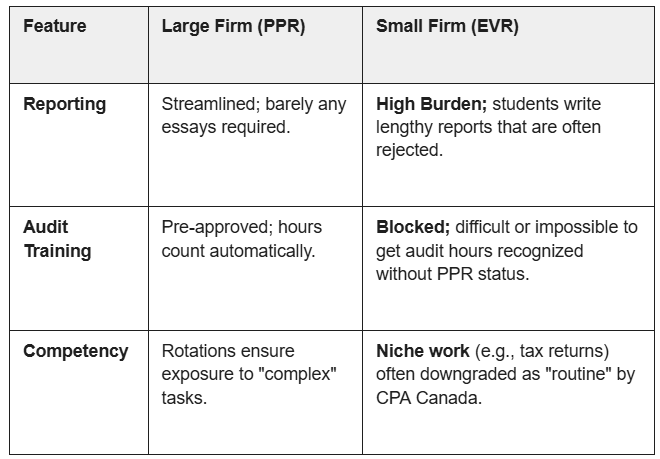
The biggest obstacle for small firms is that they typically cannot qualify as a Pre-Approved Program Route (PPR) office, which is the standard for Big 4 and mid-sized firms. Instead, small firms must use the Experience Verification Route (EVR).
- The Reporting Burden: Under EVR, students must write detailed essays (PERTs) proving their competencies.1 These are frequently rejected or downgraded by CPA reviewers who often do not understand the context of small firm work.
- The “Complexity” Hurdle: The current map requires students to demonstrate “Level 2” proficiency (complex, non-routine work) in specific technical areas. Small firms often perform repetitive, high-volume compliance work (NTRs, tax returns) which CPA Canada reviewers often deem “too simple” to count as Level 2 experience, preventing the student from getting designated.
2. The “Audit Stream” Blockade
If you are looking to train a replacement who can eventually sign off on Audits or Review Engagements, the current rules are extremely restrictive.
- PPR Requirement: In many provinces, you effectively cannot train a student in the Audit stream unless you are a Pre-Approved Program (PPR). If your firm is not pre-approved, your students cannot get the necessary “chargeable assurance hours” recognized for licensure.
- Catch-22: To become a PPR, you need a critical mass of students and a dedicated training principal, which is often unfeasible for a 1–2 partner firm. This forces small firms to hire CPAs who were trained elsewhere (usually at larger firms) rather than training their own from scratch.
3. Fear of the “New” Map (CM 2.0) & Certification 2.0
You may be hearing about the upcoming Competency Map 2.0 (slated for 2027). While it promises to be more “flexible,” it poses two potential future threats to small firms:
- The Licensure Wall: The new program proposes a distinct “Licensure” stream (for public accounting) separate from the “Common” stream.2 There is concern that this will further formalize the divide, making it even harder for a student in a small, generalist firm to “bridge the gap” to becoming a licensed public accountant.
- Ambiguity: The new map focuses less on technical knowledge lists and more on high-level skills.3 For small firms without HR departments, this lack of prescriptive checklists makes it harder to know exactly what tasks to assign students to ensure they pass.
Summary Comparison
Impact on Your Succession Plan
If you are a 1–2 partner firm looking for a replacement:
- Training a Student is Risky: You risk investing 30 months in a student who may quit because they cannot get their experience reports approved by CPA Canada while working for you.
- Hiring is Harder: You are likely forced to hire already-designated CPAs, who are currently in short supply and command higher salaries.
Sources:
The New CPA Professional Program
Certification Map 2.0: A New Pathway To Becoming a CPA – Canadian Tax Foundation