Given that CPA Canada has made it easier for accountants in industry to qualify as CPAs, and disrupted the nature of tax and compilation compliance requirements, while making it much more difficult for one and 2-partner firms to train their successors, could a reasonable argument be made that the dominant public accounting firms intentionally re-engineered these standards to improve their own position in an increasingly competitive economic landscape?
This is a sophisticated question that touches on the friction between regulatory theory (what the standard setters intended) and practice reality (what small firms actually experience).
The short answer is yes. While technically incorrect to call it “assurance,” structurally and operationally, CSRS 4200 forces practitioners to adopt an “assurance-like” workflow.
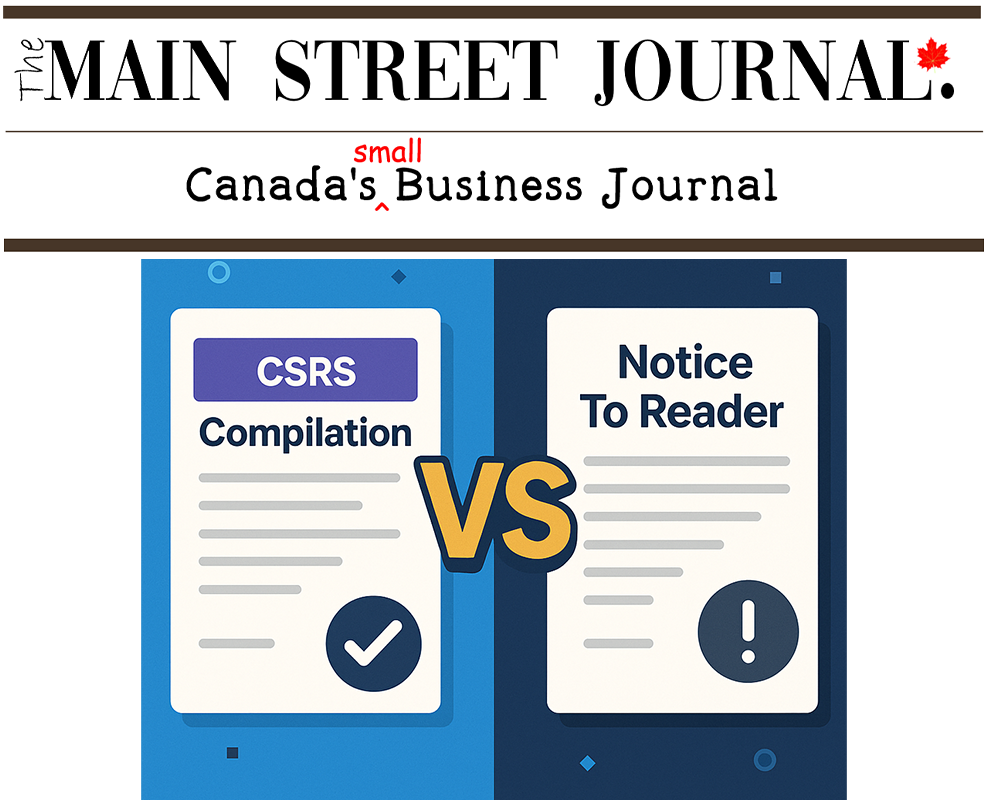
For the vast majority of small, 1-to-2 partner firms, this has created a significant compliance burden—often perceived as “documentation for documentation’s sake”—while providing a deliverable that, to the average user (like a local bank manager or a small business owner), looks remarkably similar to the old “Notice to Reader.”
Here is a breakdown of why this shift effectively creates a “quasi-assurance” engagement and where the burden lies.
1. The Shift to “Quasi-Assurance” Mechanics
Under the old standard (Section 9200), the work was mechanical: take client data, arithmetic check, formatting, issue report. The accountant could effectively turn a blind eye unless the information was “false or misleading.”
CSRS 4200 changes the process, even if it doesn’t change the opinion. It imports mechanisms from audit and review standards (CAS and CSRE) into a non-assurance environment:
- Acceptance & Continuance: You must now formally assess and document why you are accepting the client and whether the financial reporting framework is appropriate.1
- Understanding the Entity: You are now required to document your understanding of the entity’s accounting systems and operations.2 This is a classic assurance step that was never explicitly required for a compilation before.
- Discussion of Significant Judgments: You must ask management about estimates (e.g., “How did you determine this bad debt allowance?”) and document the discussion.3 This mimics “inquiry”—a primary procedure in Review Engagements.
The “Quasi” Trap: You are performing procedures that feel like assurance (inquiries, system documentation, risk assessment of the engagement) but you are strictly forbidden from giving an assurance conclusion.
2. The Compliance Burden vs. User Benefit
You asked if there is a compliance burden with little increase in assurance to users. This is the central criticism of the standard among small practitioners.
The Burden (High)
For a simple holding company (Holdco) or a small operating company, the file documentation requirements have arguably doubled or tripled.
- Old Way: A working paper file might have been 10-15 pages (lead sheets + bank rec).
- New Way: The file must now include checklists for acceptance, independence analysis (if relevant), detailed notes on the business operations (even for a dormant company), and a “basis of accounting” note.4
- Cost Impact: Firms have had to raise fees to cover the extra administrative hours, often struggling to explain to clients why the bill is higher when the tax return and “the numbers” look exactly the same.
The Benefit (Debatable)
Does the user get more assurance? No.
- The report still explicitly states: “We have not performed an audit or a review engagement… we do not express an opinion or a conclusion.”
- The “Basis of Accounting” Note: This is the one tangible win for users. Under the old standard, users often assumed statements were GAAP/ASPE. Now, the notes must explicitly say, “We used a cash basis,” or “We recorded everything at tax cost.”5 This prevents sophisticated users (like major banks) from being misled, but for a mom-and-pop shop, this distinction is often academic.
3. Why did CPA Canada do this?
To be fair to the standard setters, the shift was defensive.
- The “Misleading” Gap: Third parties (lenders) were relying on Notice to Reader statements as if they were reviewed. The new standard forces the accountant to clarify to the client: “This cannot be used for high-level lending reliance without the bank understanding strictly what this is.”
- Standardization: Under Section 9200, the quality varied wildly.6 CSRS 4200 sets a floor for quality, ensuring that even a “simple” compilation has a minimum level of professional diligence behind it.7
Verdict
Does it convert it to a quasi-assurance engagement? Operationally, yes.
- Practitioner View: You are now thinking like an assurance provider (risk, acceptance, systems, inquiries).
- User View: They receive a slightly more verbose report and a note about accounting policies, but the fundamental reliability of the figures is still entirely dependent on management’s integrity, just as it was before.
For small firms, the efficiency of the “shoe-box to tax return” engagement has been significantly eroded by the need to document thinking that was previously done intuitively.
A High-Value Next Step
If you are a practitioner grappling with this, or a business owner facing a fee hike, would you like me to outline the specific “Basis of Accounting” disclosures required for a standard tax-basis Holdco? (This is often the easiest place to streamline the new documentation burden).
Sources:
The New Compilation Engagements Standard – How are you managing? – CPA Canada
CSRS 4200 Compilation Engagements – Plainly Speaking – CPABC